
Snapdragon vs Apple Silicon: Which Processor Is Better in 2026?
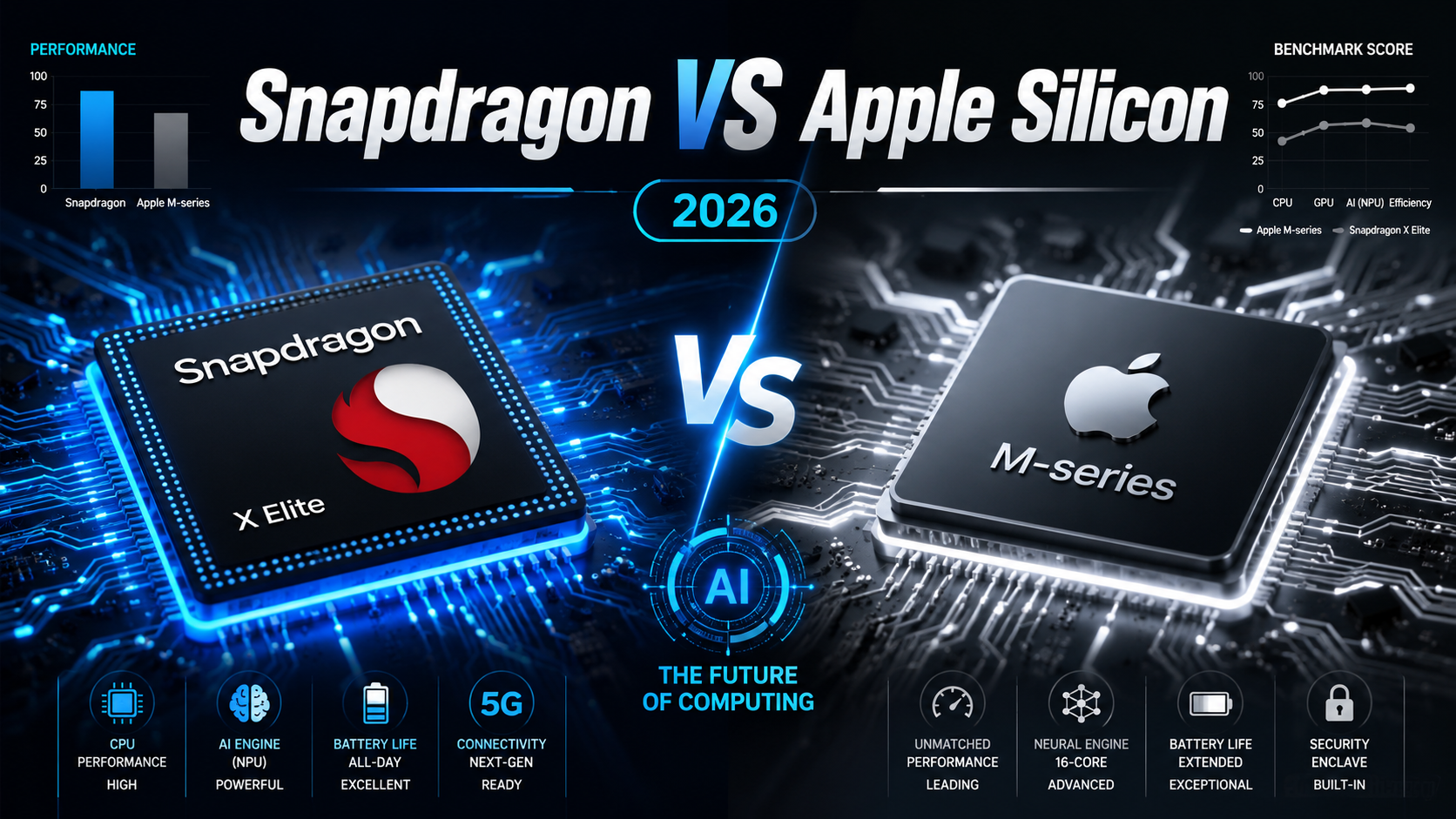
Snapdragon vs Apple Silicon: Which Processor Is Better in 2026?
Discover how Qualcomm Snapdragon and Apple Silicon compare in performance, AI capabilities, battery life, gaming, productivity, and real-world usage. Whether you're buying a new smartphone or laptop, this in-depth comparison will help you choose the best processor for your needs in 2026.
Snapdragon vs Apple Silicon: Which Processor Is Better in 2026?
The processor is the heart of every smartphone, tablet, and laptop. It determines how fast your device performs, how long the battery lasts, how smoothly games run, and even how efficiently AI-powered features work. In 2026, two processor families stand out from the competition: Qualcomm Snapdragon and Apple Silicon.
Both companies have embraced ARM-based computing, but they have taken different approaches. Qualcomm has expanded beyond smartphones into Windows laptops with the Snapdragon X Elite and Snapdragon X Plus, while Apple continues to refine its custom-designed M-series chips, including the Apple M4 and the latest Apple M5.
Choosing between these processors is no longer as simple as deciding between Android and macOS. AI-powered computing, battery efficiency, thermal performance, graphics capabilities, and software optimization now play a much bigger role than raw processing speed alone.
In this comprehensive guide, we'll compare Snapdragon vs Apple Silicon across every major category, including CPU performance, GPU power, AI processing, battery life, gaming, software compatibility, benchmarks, and real-world performance. By the end, you'll know which processor is the better choice for your specific needs in 2026.
What Is Qualcomm Snapdragon?
Qualcomm is one of the world's leading semiconductor companies, best known for developing the Snapdragon family of processors. For more than a decade, Snapdragon chips have powered many of the world's most popular Android smartphones from brands such as Samsung, Xiaomi, OnePlus, Honor, ASUS, and Motorola.
However, Qualcomm's ambitions extend far beyond smartphones. With the introduction of the Snapdragon X Elite and Snapdragon X Plus, the company has entered the laptop market to compete directly with Apple's M-series processors.
A Brief History of Snapdragon
Snapdragon processors first appeared in smartphones in the late 2000s. Over the years, Qualcomm focused on delivering an excellent balance of performance, power efficiency, and connectivity.
The company pioneered technologies such as:
Integrated 5G modems
Advanced AI processing
High-performance mobile gaming
Fast charging
Superior camera image processing
Wi-Fi 7 support
Satellite connectivity on supported devices
Today, Snapdragon processors power billions of devices worldwide.
Snapdragon Architecture
Modern Snapdragon processors use the ARM instruction set but feature Qualcomm's own custom technologies to maximize efficiency and performance.
A Snapdragon chip typically integrates several key components into a single System-on-Chip (SoC):
CPU
GPU
Neural Processing Unit (NPU)
Image Signal Processor (ISP)
Security processor
AI Engine
5G modem
Wi-Fi and Bluetooth controllers
This integrated design reduces power consumption while improving overall performance.
Snapdragon Product Lineup
Qualcomm offers different Snapdragon processors for different types of devices.
Snapdragon 8 Series
Designed for flagship Android smartphones.
Ideal for:
Gaming
AI features
Photography
Video recording
Multitasking
Examples include premium phones from Samsung, OnePlus, Xiaomi, and ASUS.
Snapdragon 7 Series
Built for upper mid-range smartphones.
Offers:
Excellent battery life
Strong gaming performance
Good cameras
Affordable pricing
Snapdragon 6 and 4 Series
These processors target budget-friendly smartphones while still delivering dependable everyday performance.
Perfect for:
Social media
Video streaming
Web browsing
Everyday apps
Snapdragon X Elite
The Snapdragon X Elite represents Qualcomm's biggest leap into the laptop market.
It was designed specifically to challenge Apple's M-series processors and traditional Intel and AMD chips.
Key highlights include:
Custom Oryon CPU cores
Dedicated AI engine
Excellent battery efficiency
Advanced integrated graphics
Windows on ARM optimization
Support for Microsoft Copilot+ PCs
The Snapdragon X Elite focuses on delivering desktop-class performance while maintaining exceptional battery life.
Snapdragon X Plus
Positioned below the X Elite, the Snapdragon X Plus provides many of the same AI and efficiency benefits at a lower price point, making it an attractive option for students, professionals, and everyday users.
Snapdragon AI Engine
Artificial intelligence has become one of the biggest differentiators between modern processors.
Qualcomm includes a dedicated AI Engine that accelerates tasks such as:
Image generation
Voice recognition
Real-time translation
Photo enhancement
Video editing
Background blur
Noise cancellation
AI assistants
These features can run directly on the device without sending sensitive data to the cloud, improving both privacy and responsiveness.
Strengths of Snapdragon
Qualcomm has several advantages in today's market.
Excellent Connectivity
Snapdragon processors often include:
Integrated 5G
Wi-Fi 7
Bluetooth 5.4
Advanced GPS
Satellite communication support (on compatible devices)
This makes Snapdragon-powered devices highly versatile for users who prioritize connectivity.
Broad Device Availability
Unlike Apple Silicon, Snapdragon processors are used by numerous manufacturers, giving consumers a wide range of choices across different price points.
Strong AI Capabilities
Qualcomm has invested heavily in AI acceleration, enabling features such as:
AI-powered cameras
Live transcription
AI-generated images
Smart voice assistants
Productivity enhancements
What Is Apple Silicon?
Apple Silicon refers to Apple's family of custom-designed ARM-based processors that power Mac computers, iPads, and other Apple devices.
Before introducing Apple Silicon, Macs relied on Intel processors. While Intel chips delivered strong performance, they often consumed more power and generated more heat than Apple wanted for its future devices.
In 2020, Apple began transitioning its Mac lineup from Intel to its own custom processors, starting with the revolutionary M1 chip. That move dramatically improved performance, battery life, and efficiency.
Since then, Apple has introduced several generations of processors, including:
M1
M2
M3
M4
M5
Each generation has brought significant improvements in CPU performance, graphics, AI processing, and energy efficiency.
Why Apple Designed Its Own Chips
Apple's goal was simple: create processors specifically optimized for its hardware and software ecosystem.
Instead of relying on third-party chip manufacturers, Apple designs both the processor and the operating system.
This close integration allows Apple to optimize:
Battery life
Thermal management
Application performance
Security
Memory management
AI processing
The result is an exceptionally smooth user experience across MacBooks, iPads, and other Apple devices.
Apple Silicon Architecture
Apple Silicon is also based on the ARM architecture, but Apple designs nearly every aspect of the chip in-house.
Each processor includes:
High-performance CPU cores
High-efficiency CPU cores
Integrated GPU
Neural Engine
Unified Memory Architecture (UMA)
Media Engine
Secure Enclave
Image Signal Processor
Rather than maximizing benchmark scores alone, Apple focuses on delivering balanced, real-world performance with minimal power consumption.
Unified Memory Architecture (UMA)
One of the defining features of Apple Silicon is its Unified Memory Architecture.
Traditional computers often allocate separate memory for the CPU and GPU. Apple instead uses a shared memory pool that both processors can access simultaneously.
This design offers several benefits:
Faster data sharing
Reduced latency
Lower power consumption
Improved performance in creative applications
Better multitasking
For tasks such as 4K video editing, photo editing, and 3D rendering, Unified Memory helps Apple Silicon deliver impressive efficiency.
Apple Neural Engine
Apple includes a dedicated Neural Engine in every Apple Silicon processor.
The Neural Engine accelerates AI tasks including:
Apple Intelligence features
Image recognition
Live text
Voice dictation
Face ID processing
Photo enhancement
Video analysis
Language translation
Many of these tasks are performed directly on the device, enhancing both privacy and speed.
Apple M4 and Apple M5
The Apple M4 introduced notable improvements in AI performance, graphics processing, and energy efficiency, making it a strong choice for professionals and creators.
The newer Apple M5 builds on that foundation with faster CPU and GPU performance, improved machine learning capabilities, and better support for demanding workloads. While exact performance varies by device configuration, Apple continues to focus on maximizing performance per watt, ensuring users receive excellent speed without sacrificing battery life.
Snapdragon vs Apple Silicon: Architecture Comparison
Although both processor families are based on ARM technology, they are designed with different priorities.
| Feature | Snapdragon | Apple Silicon |
|---|---|---|
| Architecture | ARM-based SoC | ARM-based SoC |
| Primary Devices | Android phones, Windows laptops | Macs, iPads |
| CPU Design | Qualcomm Oryon and Kryo cores | Custom Apple CPU cores |
| AI Engine | Qualcomm Hexagon NPU | Apple Neural Engine |
| Graphics | Adreno GPU | Apple Integrated GPU |
| Memory | LPDDR5X/LPDDR6 (device-dependent) | Unified Memory Architecture |
| Connectivity | Built-in 5G, Wi-Fi 7, Bluetooth | External cellular on Macs; integrated wireless varies by device |
| Ecosystem | Android and Windows | Apple ecosystem |
Both companies have created highly capable ARM processors, but they target different audiences. Snapdragon prioritizes flexibility across multiple manufacturers and platforms, while Apple Silicon emphasizes tight hardware and software integration within the Apple ecosystem.
CPU Performance Comparison
CPU performance affects everything from launching applications and browsing the web to compiling code and editing videos.
Apple Silicon has consistently delivered outstanding single-core performance, which helps applications feel exceptionally responsive. This advantage is particularly noticeable in everyday tasks such as opening apps, switching between programs, and editing documents.
Qualcomm's latest Snapdragon X Elite, powered by custom Oryon cores, has significantly narrowed the gap. It delivers strong multi-core performance and offers excellent efficiency for productivity workloads, making Windows on ARM devices far more competitive than previous generations.
For users focused on sustained performance in creative software, Apple Silicon generally maintains an edge thanks to its deep optimization with macOS. However, Snapdragon has become a compelling choice for Windows users seeking long battery life and AI-enhanced productivity.
GPU Performance Overview
Graphics performance plays a crucial role in gaming, video editing, 3D rendering, and AI-assisted creative tasks.
Apple's integrated GPU is highly optimized for professional applications such as Final Cut Pro, Logic Pro, and other software designed specifically for macOS. Unified Memory Architecture also helps reduce bottlenecks when handling large graphics workloads.
Qualcomm's Adreno GPU has long been a leader in mobile graphics, and its latest laptop-class graphics continue to improve. Snapdragon processors deliver smooth performance for everyday graphics tasks, casual gaming, and AI-accelerated workloads while maintaining impressive power efficiency.
For demanding professional graphics work, Apple Silicon currently holds a performance advantage in many optimized applications. However, Snapdragon continues to make rapid progress, particularly as more Windows software is optimized for ARM-based processors.
Benchmark Comparison
Benchmarks provide a standardized way to measure processor performance, but they don't always reflect real-world usage. A processor that scores higher in a benchmark may not necessarily deliver a noticeably better experience in everyday tasks. Factors such as software optimization, cooling systems, memory configuration, and operating system efficiency all influence actual performance.
That said, benchmark results offer a useful starting point when comparing Snapdragon and Apple Silicon.
Snapdragon vs Apple Silicon Benchmark Comparison
| Benchmark | Snapdragon X Elite | Apple M4 | Apple M5* |
|---|---|---|---|
| Geekbench Single-Core | Excellent | Outstanding | Outstanding+ |
| Geekbench Multi-Core | Excellent | Excellent | Outstanding |
| Cinebench Multi-Core | Very Good | Excellent | Outstanding |
| AI Processing (NPU) | Excellent | Excellent | Outstanding |
| GPU Performance | Very Good | Excellent | Outstanding |
| Battery Efficiency | Excellent | Outstanding | Outstanding |
| Thermal Efficiency | Excellent | Outstanding | Outstanding |
*Performance may vary depending on device configuration, cooling solution, memory capacity, operating system version, and software updates.
Key Takeaways
Apple Silicon continues to lead in single-core performance, making macOS feel exceptionally responsive.
Snapdragon X Elite has dramatically improved multi-core performance, making it highly competitive for productivity tasks.
Apple's integrated GPU generally performs better in creative applications optimized for macOS.
Qualcomm's AI engine delivers excellent performance for Windows AI workloads and Microsoft Copilot+ features.
Both processor families are among the most power-efficient ARM chips available in 2026.
Gaming Performance
Gaming performance depends on much more than raw processor speed. Graphics capabilities, software optimization, cooling, and driver support all contribute to the overall experience.
Let's compare how Snapdragon and Apple Silicon perform across different gaming scenarios.
Mobile Gaming
Snapdragon processors have long been the preferred choice for Android gaming devices.
Popular titles such as:
PUBG Mobile
Call of Duty: Mobile
Genshin Impact
Asphalt Legends
Fortnite (where available)
Honor of Kings
run smoothly on flagship Snapdragon-powered smartphones.
Advantages include:
Stable frame rates
Excellent thermal management
High refresh rate support
Hardware-accelerated ray tracing on supported devices
Broad game compatibility
If you're primarily an Android gamer, Snapdragon remains one of the strongest choices available.
Mac Gaming
Apple has significantly improved gaming support in recent years.
With Apple Silicon, users can enjoy impressive performance in titles optimized for macOS, including games available through the App Store and an increasing number of AAA releases.
Benefits include:
Excellent graphics efficiency
Quiet operation
Low heat generation
Long battery life while gaming
However, the biggest challenge remains game availability. Many Windows-exclusive titles still lack native macOS versions, although compatibility tools continue to improve.
Windows Gaming on Snapdragon
Windows on ARM has matured considerably, but gaming is still evolving.
Modern Snapdragon X Elite laptops can comfortably handle:
Casual games
Cloud gaming
Indie titles
Older PC games
Some modern AAA games with native ARM support
As more developers optimize games for ARM-based Windows devices, gaming performance is expected to improve further.
Emulation Performance
Both Snapdragon and Apple Silicon support emulation, but their strengths differ.
Snapdragon
Suitable for:
Classic console emulators
Android emulation
Some Windows x86 applications through translation layers
Apple Silicon
Excellent for:
Retro console emulation
macOS-native emulators
Development and testing environments
Performance varies depending on the emulator and software optimization.
Thermal Performance During Gaming
Heat affects long gaming sessions.
Snapdragon
Advantages:
Efficient cooling
Stable sustained performance
Lower thermal throttling on well-designed devices
Apple Silicon
Advantages:
Exceptional performance per watt
Quiet cooling systems
Consistent performance during creative workloads
For prolonged gaming sessions, both platforms perform well, though Apple's tight hardware and software integration often results in more consistent thermal efficiency.
Gaming Verdict
Choose Snapdragon if you:
Prefer Android gaming
Play competitive mobile games
Want maximum compatibility
Need higher refresh-rate support
Choose Apple Silicon if you:
Game casually on macOS
Prefer battery efficiency
Also perform creative work such as video editing or graphic design
AI Performance
Artificial Intelligence has become one of the biggest reasons to upgrade a processor in 2026.
Modern processors no longer rely solely on the CPU for AI workloads. Dedicated Neural Processing Units (NPUs) accelerate machine learning tasks while reducing power consumption.
Snapdragon AI Engine
Qualcomm has invested heavily in on-device AI.
The Snapdragon AI Engine enables:
AI-powered image generation
Live captions
Real-time language translation
Noise cancellation
AI-powered webcams
Voice recognition
Background removal
Document summarization
Microsoft Copilot+ features
Many of these tasks are processed locally, improving both speed and privacy.
Apple Neural Engine
Apple's Neural Engine powers many intelligent features across macOS and iPadOS.
Capabilities include:
Apple Intelligence
Writing assistance
Smart photo editing
Face recognition
Live Text
Voice transcription
AI-powered search
On-device language translation
Intelligent Siri improvements
Because Apple controls both the hardware and software, these AI features often feel seamlessly integrated into the user experience.
AI Performance Comparison
| Feature | Snapdragon | Apple Silicon |
|---|---|---|
| Dedicated NPU | Yes | Yes |
| AI Image Generation | Excellent | Excellent |
| Local AI Processing | Excellent | Outstanding |
| AI Photo Editing | Excellent | Outstanding |
| Live Translation | Excellent | Excellent |
| AI Productivity | Excellent | Outstanding |
| Ecosystem Integration | Very Good | Excellent |
Which AI Platform Is Better?
Snapdragon excels in Windows AI experiences and Copilot+ integration.
Apple Silicon shines through deep integration with Apple Intelligence and the broader Apple ecosystem.
For most users, both platforms provide fast, secure, and efficient on-device AI capabilities.
Battery Life Comparison
Battery life has become one of the most important purchasing factors.
Both Snapdragon and Apple Silicon are built on ARM architecture, which prioritizes efficiency without sacrificing performance.
Everyday Productivity
Tasks such as:
Web browsing
Email
Microsoft Office
Google Docs
Video conferencing
consume very little power on both platforms.
Apple typically delivers exceptional endurance on MacBooks thanks to tight hardware and software optimization, while Snapdragon-powered Windows laptops also offer impressive all-day battery life.
Video Playback
Streaming movies or watching downloaded videos is another area where both platforms excel.
Apple Silicon generally achieves excellent media efficiency through its dedicated Media Engine, while Snapdragon processors use specialized hardware decoders to reduce power consumption during playback.
Gaming Battery Life
Gaming naturally consumes more power than everyday tasks.
However, both processor families maintain relatively low power usage compared to many traditional x86 laptops.
Apple Silicon generally provides slightly longer battery life during sustained creative and multimedia workloads, while Snapdragon remains highly competitive for productivity and light gaming.
Standby Efficiency
ARM processors consume very little energy when idle.
Benefits include:
Instant wake-up
Long standby time
Reduced background power consumption
These features make both Snapdragon and Apple Silicon excellent choices for users who travel frequently or work remotely.
Software Ecosystem
Hardware is only part of the story. Software optimization can have an even greater impact on the overall user experience.
Snapdragon Ecosystem
Snapdragon processors support:
Windows on ARM
Android
Microsoft Copilot+
Google Workspace
Microsoft Office
Adobe applications (optimized versions)
Increasing native ARM software support
The Windows ecosystem continues to improve as more developers release native ARM applications.
Apple Ecosystem
Apple Silicon integrates seamlessly with:
macOS
iPhone
iPad
Apple Watch
AirPods
iCloud
Final Cut Pro
Logic Pro
Xcode
Features such as Handoff, Universal Clipboard, AirDrop, Continuity Camera, and iPhone Mirroring create a highly connected ecosystem that enhances productivity for users who own multiple Apple devices.
Real-World Performance
Synthetic benchmarks are useful, but day-to-day performance matters most.
Here's how both platforms perform in common workloads.
| Task | Snapdragon | Apple Silicon |
|---|---|---|
| Web Browsing | Excellent | Outstanding |
| Microsoft Office | Excellent | Outstanding |
| Programming | Excellent | Outstanding |
| Photoshop | Very Good | Excellent |
| Lightroom | Very Good | Excellent |
| Video Editing | Very Good | Outstanding |
| Blender | Good | Excellent |
| Multitasking | Excellent | Outstanding |
| AI Workloads | Excellent | Outstanding |
| Battery Life | Excellent | Outstanding |
Pros and Cons
Snapdragon
Pros
Excellent battery efficiency
Strong AI performance
Integrated 5G connectivity
Broad selection of devices
Competitive pricing
Great Windows compatibility
Outstanding Android gaming experience
Cons
Windows on ARM app compatibility is still improving
Fewer professional creative applications are fully optimized compared to macOS
Performance varies across manufacturers
Apple Silicon
Pros
Industry-leading performance per watt
Exceptional battery life
Outstanding creative performance
Excellent software optimization
Powerful Neural Engine
Seamless Apple ecosystem integration
Consistent user experience across devices
Cons
Premium pricing
Limited upgrade options after purchase
Best experience requires investment in the Apple ecosystem
Fewer gaming titles compared to Windows
Snapdragon vs Apple Silicon: Quick Comparison Table
| Feature | Snapdragon | Apple Silicon |
|---|---|---|
| CPU Performance | ★★★★☆ | ★★★★★ |
| GPU Performance | ★★★★☆ | ★★★★★ |
| AI Performance | ★★★★★ | ★★★★★ |
| Battery Life | ★★★★★ | ★★★★★ |
| Gaming | ★★★★★ (Android/Windows) | ★★★★☆ (macOS) |
| Productivity | ★★★★★ | ★★★★★ |
| Software Optimization | ★★★★☆ | ★★★★★ |
| Ecosystem | Android & Windows | Apple Ecosystem |
| Value for Money | Excellent | Premium |
| Best For | Windows users, Android users, AI PCs | Mac users, creators, professionals |
Best for Students
Recommended: Snapdragon X Plus / Snapdragon X Elite
Students typically need a laptop that offers:
Long battery life
Lightweight design
Microsoft Office compatibility
Affordable pricing
Reliable performance for online learning
Snapdragon-powered Windows laptops excel in these areas and often cost less than comparable MacBooks.
Why Snapdragon?
Excellent battery life
Lower purchase price
Full Microsoft Office support
AI-powered productivity tools
Instant-on experience
Apple Silicon is also a great choice for students already invested in the Apple ecosystem or studying creative subjects such as graphic design or video production.
Best for Professionals
Recommended: Apple Silicon
Professionals working with demanding applications benefit from Apple's excellent hardware and software optimization.
Ideal for:
Productivity
Multitasking
Business applications
Video conferencing
Creative workflows
Apple's exceptional battery efficiency also makes MacBooks excellent travel companions.
Best for Developers
macOS Developers
If you develop:
iOS Apps
macOS Applications
Swift Projects
Apple Silicon is the clear winner.
Applications like:
Xcode
Docker
Terminal
Homebrew
run exceptionally well on Apple hardware.
Windows Developers
Developers working with:
.NET
Visual Studio
Azure
Windows Applications
may prefer Snapdragon-powered Windows laptops, especially as Windows on ARM continues to mature.
Best for Content Creators
Recommended: Apple Silicon
Content creators working with:
Adobe Premiere Pro
Final Cut Pro
DaVinci Resolve
Photoshop
Lightroom
Logic Pro
benefit from Apple's powerful GPU, Media Engine, and Unified Memory Architecture.
Rendering large video projects is often faster and more power-efficient on Apple Silicon.
Best for Gamers
Mobile Gaming
Winner: Snapdragon
Flagship Snapdragon smartphones continue to deliver some of the best Android gaming experiences available.
Laptop Gaming
Winner: Windows Gaming PCs
Although Snapdragon laptops continue to improve, dedicated gaming laptops with discrete GPUs remain the preferred option for serious PC gamers.
Apple Silicon performs impressively in supported games, but the overall game library is still smaller than Windows.
Best for Travelers
Winner: Tie
Both Snapdragon and Apple Silicon offer:
Outstanding battery life
Instant wake
Quiet operation
Excellent portability
If long battery life is your highest priority, you can't go wrong with either platform.
Best for Business Users
Businesses that rely heavily on:
Microsoft Teams
Microsoft Office
Outlook
SharePoint
may find Snapdragon-powered Windows laptops particularly attractive.
Companies already invested in Apple's ecosystem will naturally benefit more from MacBooks powered by Apple Silicon.
Final Buying Recommendations
User Type Recommended Processor Students Snapdragon X Plus Office Users Snapdragon X Elite Business Professionals Apple Silicon Developers Depends on Platform Video Editors Apple Silicon Graphic Designers Apple Silicon Travelers Either Android Users Snapdragon Apple Users Apple Silicon Casual Gamers Either Mobile Gamers Snapdragon Frequently Asked Questions (FAQ)
1. Is Snapdragon better than Apple Silicon?
It depends on your needs. Snapdragon is an excellent choice for Windows laptops and Android devices, while Apple Silicon offers industry-leading performance, efficiency, and software optimization for Macs and iPads.
2. Which processor has better battery life?
Both processor families provide exceptional battery life thanks to their ARM-based architecture. Apple Silicon often holds a slight advantage in MacBooks due to deep hardware and software integration, while Snapdragon-powered Windows laptops also deliver excellent all-day endurance.
3. Is Snapdragon X Elite faster than Apple M4?
The Snapdragon X Elite is highly competitive in multi-core workloads, but the Apple M4 generally maintains stronger single-core performance and excels in applications optimized for macOS.
4. Which processor is best for AI?
Both platforms feature powerful dedicated AI engines. Snapdragon integrates closely with Microsoft Copilot+, while Apple Silicon powers Apple Intelligence and other on-device AI features. The best choice depends on your preferred ecosystem.
5. Which processor is better for gaming?
Snapdragon remains the stronger choice for Android gaming, while Apple Silicon performs exceptionally well in macOS games that are optimized for Apple hardware. Dedicated Windows gaming laptops with discrete GPUs still lead for high-end PC gaming.
6. Is Apple Silicon worth buying in 2026?
Yes. Apple Silicon continues to offer outstanding performance, excellent battery life, advanced AI capabilities, and a seamless user experience, making it a great investment for professionals, creators, and everyday users.
7. Is Snapdragon good for programming?
Absolutely. Snapdragon-powered Windows laptops are well suited for programming, web development, and productivity tasks, especially as more development tools gain native ARM support.
8. Which processor is more power efficient?
Both processors are among the most power-efficient available. Apple Silicon has a slight advantage in performance per watt, while Snapdragon also delivers impressive efficiency, particularly in Windows laptops and Android devices.
9. Which processor is better for video editing?
Apple Silicon generally performs better for video editing because of its dedicated Media Engine, Unified Memory Architecture, and optimization for applications like Final Cut Pro and DaVinci Resolve.
10. Which processor should I buy in 2026?
Choose Snapdragon if you prefer Windows laptops or Android devices and want excellent AI features, battery life, and value. Choose Apple Silicon if you use Apple's ecosystem or need top-tier creative performance and seamless hardware-software integration.
Final Verdict
The competition between Snapdragon and Apple Silicon has never been closer. Qualcomm has made remarkable progress with the Snapdragon X Elite and Snapdragon X Plus, bringing ARM-based Windows laptops into direct competition with Apple's M-series processors.
Apple Silicon still leads in several areas, including single-core performance, creative workloads, and ecosystem integration. Its combination of performance, efficiency, and software optimization continues to set a high standard for premium laptops.
Snapdragon, however, stands out for its flexibility, broad hardware availability, excellent AI capabilities, integrated connectivity, and growing Windows on ARM ecosystem. For users who prefer Windows or Android, Snapdragon is now a compelling and highly capable choice.
Ultimately, there is no single winner. The best processor depends on your operating system, preferred software, budget, and workflow.
Choose Snapdragon if you:
Prefer Windows or Android
Want integrated 5G and modern connectivity
Need strong AI features with Microsoft Copilot+
Want excellent battery life at competitive prices
Choose Apple Silicon if you:
Use macOS, iPhone, or iPad
Work with creative applications
Need maximum performance per watt
Value seamless ecosystem integration and long-term software support
No matter which platform you choose, both Snapdragon and Apple Silicon represent the future of ARM computing and are among the best processors available in 2026.
Conclusion
Whether you choose Qualcomm Snapdragon or Apple Silicon, you're investing in two of the most advanced ARM-based processor platforms available today. Snapdragon offers flexibility, AI innovation, and excellent value across Windows and Android devices, while Apple Silicon continues to excel in efficiency, creative performance, and ecosystem integration. By understanding your priorities—whether it's gaming, content creation, productivity, or battery life—you can confidently select the processor that best fits your needs in 2026.